How coal-handling and preparation plants can link a live conveyor moisture trend to an agreed total-moisture reference, compensate for changing bed depth, and use the signal for earlier process decisions.
Start with an agreed total-moisture reference, not an instrument number alone
Coal moisture influences material handling, preparation, blending, drying, and fuel use, but “moisture” is only useful when the plant agrees exactly what it means. ASTM D3302/D3302M covers total moisture in coal as it exists at the place, time, and conditions of sampling, for coal as mined, processed, shipped, or used. Its scope emphasizes gross-sample collection, sample preparation, and the determination itself because coal can range from water-saturated to dry. Treat that laboratory result as the approved comparator for an online signal; do not assume that a later sample from a different conveyor, stockpile, or hopper represents the same material.
Record the reporting basis beside every value. On an as-received, wet basis, a 1,000 kg conveyor sample at 12% total moisture contains 120 kg of water and 880 kg of dry solids. The same water is 13.6% on a dry basis. This distinction becomes material when production trends, laboratory certificates, supplier data, and energy calculations are compared. It also prevents a live control trend from being incorrectly treated as a settlement or referee result.
The measurement challenge: a conveyor bed is not a uniform laboratory sample
Rain, drainage, wash-plant operation, coal rank, particle-size distribution, fines fraction, bulk density, belt speed, loading, and segregation can all change the relationship between an instrument response and a grab sample. Water may also be unevenly distributed through the bed. The U.S. Geological Survey advises that coal samples should be shipped to the laboratory within a few days to limit the effects of oxidation and air exposure on moisture, a useful reminder that sampling and handling are part of the measurement system. Its coal-sampling guidance also stresses that the representative sampling plan depends on the material and site.
For a conveyor application, two questions need separate answers: does the sensor see the same cross-section and time window as the reference sample, and can it distinguish water from changing mass per unit area? A 2002 Fuel Processing Technology study selected the feeder point in a thermal-power fuel circuit and used a microwave installation that passed through the material layer. The authors reported that through-layer measurement removed the vertical coal-and-water segregation seen by a single-point capacitive approach. That is evidence for reviewing geometry and load compensation, not a universal accuracy claim for every coal, belt, or installation.
Recommended instrumentation approach
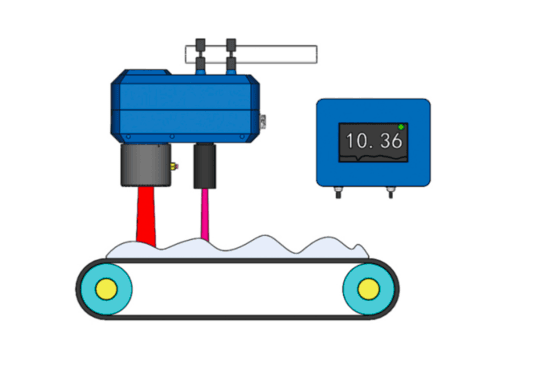
When the operating decision depends on average moisture through a thick, dense, or variable-depth coal stream, evaluate a through-layer microwave moisture measurement system. The transmitter and receiver should be located so that the signal passes through a stable, well-defined material layer, and a load or distance measurement should be considered when belt burden changes. The goal is to create a repeatable representation of the moving stream, rather than to infer total-bed moisture from an exposed surface alone.
A non-contact online NIR moisture analyzer can also be evaluated where the coal is presented as a consistently spread, exposed surface and the process needs rapid surface-trend feedback. In a deep, segregated, dusty, or rapidly changing conveyor bed, confirm that a surface result supports the intended operating decision before adopting it. ALZRO's measurement-technology overview outlines the practical difference between optical surface sensing and microwave through-layer measurement.
Put the signal at the process decision point
- After dewatering or wash-plant discharge: identify a wet-feed shift early enough to adjust handling, blending, or dryer loading. Sample and calibrate on the same transfer where feasible.
- After a dryer or crusher-dryer: trend the condition being sent to a bunker, mill, gasifier, or downstream process. Treat it as a drying-control point, not proof of moisture after later storage or transfer.
- On a blend conveyor before a preparation or combustion circuit: correlate the average moisture of the actual feed with belt load, coal source, size distribution, and process response.
- At loadout: use a separate, representative point when the commercial or logistics question concerns the coal shipped, recognizing that a process instrument does not replace the agreed contractual sampling and test procedure.
Map each measurement to one response: change dryer conditions, manage a wet-coal diversion, adjust blending, schedule verification sampling, or investigate a handling issue. Include transport and averaging delay in the control narrative. An online average that arrives after the relevant material has already entered a bunker is still valuable for diagnosis, but it may not be suitable for immediate closed-loop action.
Calibration and installation: protect representativeness from day one
Build the calibration around paired, time-stamped data. Collect the reference sample from the same material stream and time period seen by the sensor, seal it promptly, and analyze it using the site's agreed method. Match the laboratory result to the online time average after allowing for material travel time. Include routine production variation—coal sources and ranks, particle-size distribution, fines, ash-related mineral content, bed depth, throughput, temperature, and normal moisture range—rather than calibrating only with one dry and one wet condition.
- Survey the belt: document width, speed, trough shape, bed-depth range, cross-belt profile, coverage, particle size, dust, vibration, metal clearances, and access for safe maintenance.
- Review loading compensation: measure or otherwise account for changing layer thickness and mass per unit area. Do not apply a model built at one belt loading to a very different burden without verification.
- Prove performance in stages: first check trend direction and repeatability; then establish a sampling schedule, operating alarms, and operator action plan; assess automatic control only after expected coal and loading variation are represented.
- Revalidate after a change: new coal sources, wash-plant settings, crusher screens, belt geometry, operating range, or sampling method can shift the model-to-reference relationship.
Quality, handling, and energy benefits to prove with site data
Continuous coal-moisture data can make a wet-feed event visible sooner, support more disciplined laboratory sampling, and help operators separate a feed-change issue from a downstream process disturbance. It does not justify a universal dryer target or a fixed energy-saving promise. In one U.S. Department of Energy NETL design case, coal at 11.12% moisture by weight was dried to about 5% using indirect low-pressure-steam heating; the values belong to that modeled gasification configuration, not to every coal or plant. The NETL report nevertheless illustrates why a traceable incoming and outgoing moisture balance matters to drying and feed consistency.
Verify value with plant evidence: paired laboratory and online results, moisture variability, belt loading, dryer heat, throughput, handling interruptions, blend performance, and downstream stability. This evidence-based approach is more useful than a generic return-on-investment number because it ties the analyzer to a specific operational decision and a specific material stream.
Sources
- ASTM D3302/D3302M-22a, Standard Test Method for Total Moisture in Coal. Scope and sampling/reference-method context for total moisture in coal.
- U.S. Geological Survey Circular 735, Guidelines on Collecting Coal Samples. Guidance on representative sampling and limiting moisture changes during handling.
- Ponte et al. (2002), Fuel Processing Technology, “Generating a representative signal of coal moisture content to anticipate combustion control in thermal power stations”. Peer-reviewed discussion of feeder selection and through-layer microwave measurement.
- U.S. DOE NETL, Coal-Based Power Plants of the Future. Modeled fluid-bed coal-drying context, including stated feed and product moisture values.