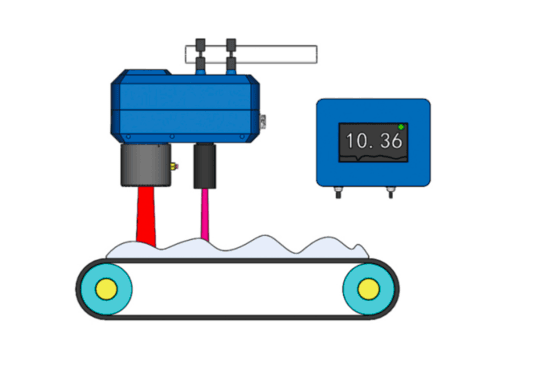
Why sinter-water control must follow ore blend and particle size, and how an online bulk-moisture signal can support more stable granulation and bed permeability.
Why sinter-mix water is a process variable, not a fixed recipe number
Before iron ore fines are charged to a sinter strand, they are blended with fluxes, fuel, and return fines, then granulated with water to form quasi-particles. The point of water addition is not simply to reach one percentage on a display. It is to create enough capillary binding for fine particles to adhere to coarser nuclei while preserving the voidage needed for gas to pass through the green bed.
The target must follow the actual blend. In a Kobe Steel study published in ISIJ International, the added moisture that maximized packed-bed permeability was below the saturation moisture for every ore tested when size distribution was held constant; adding more coarse particles also shifted the optimum toward lower moisture. That is a practical warning against copying a target from a different ore blend, season, or fines ratio.
The measurement challenge: total water is not always water available for granulation
Moisture that is absorbed into porous ore is not necessarily available at particle contacts to build stable granules. A 2018 ISIJ International granulation study defines available granulation water as total water added minus water absorbed by the feed materials, and reports that a higher fraction near 0.1 mm tends to reduce permeability and increase the moisture needed for granulation. Incoming moisture, particle-size distribution, porosity, and blend composition therefore all belong in the control context.
Water distribution also has a time component. A review of iron-ore granulation research reports that the ores it cites reached 68% to 78% of final water saturation after 60 seconds of immersion, while complete saturation typically took 105 seconds. The review uses this behavior to explain why ore texture and water migration matter during granulation. In plant terms, a sample or instrument reading taken immediately after spraying may not represent the same state as the material arriving at the strand.
What the process impact looks like
Too little available moisture can leave fines poorly attached and reduce bed permeability. Too much can over-wet the mix, deform granules, reduce voidage, and add water that must later be evaporated. The permeability response is usually a curve rather than a straight line: the 2018 study found permeability initially rose with added moisture, reached a maximum, then fell at higher moisture for the tested mixes.
The operating window can move when mixing changes. In a 2020 study of a 100% fine-grained iron-ore material, intensive mixing reduced the reported proper moisture consumption from 9.25% to 8.75% while improving granulation and sinter quality. That result is not a recommended plant target; it is evidence that mixer action and water distribution can change the amount of water a specific blend needs.
Recommended instrumentation approach
For a mixed, variable-depth sinter stream on a conveyor, start by evaluating a microwave moisture measurement system. A through-belt measurement is a logical fit when the control question is the average moisture through the moving layer rather than only the exposed surface. Load compensation should be included in the application review where bed depth varies, because a moisture signal that does not account for changing mass can confuse a thickness change with a water change.
A non-contact online NIR moisture analyzer can be evaluated for a thin, even, exposed material layer where fast surface-trend information is the objective. It should not be assumed to represent the bulk of a deep or uneven sinter bed. Method selection should be based on the material presentation, dust and steam conditions, depth range, and the specific control decision—not a nominal accuracy figure alone.
Installation points that support a useful control loop
- After water addition and primary mixing: use the trend to confirm whether the initial addition is moving with incoming-material changes.
- At granulator or mixer discharge: use a representative, settled material stream to judge the condition entering the sinter feed conveyor.
- Before strand feed: use as a verification point when transport, return-fines changes, or water migration could make the final feed differ from the earlier reading.
The ALZRO sinter-mix application page outlines these preparation, granulation, and bed-feed locations. At each candidate point, confirm belt coverage, material depth and segregation, chute geometry, vibration, metalwork clearance, dust buildup, and access for cleaning and reference sampling. A sensor must see a representative cross-section of the stream before its value can be used for water control.
Calibration and commissioning: connect the number to plant performance
Calibrate against time-stamped, representative samples collected from the same stream and analyzed by the plant's approved moisture method. Document the wet-basis or dry-basis convention, transport delay between sensor and sample point, averaging window, and bed-depth range. Collect samples across normal operating conditions instead of fitting the model only around one convenient value.
During commissioning, compare online moisture trends with permeability, mixer torque or power, suction conditions, granule-size observations, and sinter performance according to the plant's existing practice. Begin with operator guidance or a bounded advisory signal. Only consider automatic water trimming after the signal has remained stable through normal changes in ore source, return-fines rate, and weather. Revalidate the calibration when those material conditions change materially.
Quality and energy benefits to evaluate
Continuous moisture visibility does not replace granule-size checks, permeability testing, fuel control, or final sinter-quality testing. It provides an earlier input for keeping granulation near the plant's validated operating window. Used with disciplined operating rules, it can help teams identify moisture drift sooner, reduce trial-and-error adjustment after a blend change, and avoid carrying unnecessary water into the thermal process.
A sound project definition starts with the ore and return-fines recipe, incoming moisture variation, fines distribution, water-addition method, mixer residence time, belt depth, site conditions, reference method, and intended control action. Those facts determine whether an online moisture value will be a useful process variable rather than simply another number on the control screen.
Sources
- Matsumura et al., ISIJ International 49 (2009), 618–624. Ore-specific optimum moisture, saturation behavior, and particle-size effects.
- Zhou et al., ISIJ International 58 (2018). Available granulation water, particle-size distribution, and packed-bed permeability.
- Zhou et al., ISIJ International 63 (2023). Review of water migration, moisture capacity, and iron-ore granulation technology.
- Gan et al., Journal of Materials Research and Technology 9 (2020), 14443–14453. Intensive mixing, water distribution, and fine-grained sinter-feed results.