How continuous wood-fiber moisture measurement can help MDF and particleboard plants stabilize mat preparation, pressing, and final board quality.
Why wood-fiber moisture deserves a control point
In MDF and particleboard production, moisture is not only a finished-board test. It is a process variable that changes how fibers or particles move through storage, resin blending, mat forming, and the hot press. Wood is hygroscopic: its moisture condition changes with surrounding temperature and relative humidity, and that exchange affects its physical behavior. The USDA Forest Products Laboratory Wood Handbook notes that freshly sawn wood can range from about 30% to more than 200% moisture content, depending on species and wood section. That is why incoming furnish should never be treated as a fixed condition.
The operating target is product- and recipe-specific, not a universal percentage. For conventional particleboard, the same USDA reference reports mat moisture of 8% to 12% at hot pressing, falling to roughly 5% to 9% during pressing. Those figures are useful commissioning context, not a substitute for a plant's board specification, resin system, density profile, or press recipe.
The measurement challenge: average moisture can hide a moving process
Grab samples can verify a laboratory value, but they can miss short-term variation caused by wet chip deliveries, uneven dryer loading, changes in storage residence time, or shifts in ambient humidity. A single average also cannot show whether wet and dry pockets are reaching the blender. For a fiberboard line, that distinction matters because resin addition, furnish flow, and press response are all sensitive to the condition of the material actually entering the next step.
Moisture also changes heat and mass transfer during pressing. The USDA Forest Service review of hot-pressing research explains that initial mat moisture influences internal temperature rise and that heat and mass transfer are interdependent. Excess vapor pressure must be managed; simply increasing moisture or press temperature is not a reliable correction. The Forest Service's hot-pressing review further identifies vapor release as a practical limit on higher-moisture pressing approaches.
A recommended online measurement approach
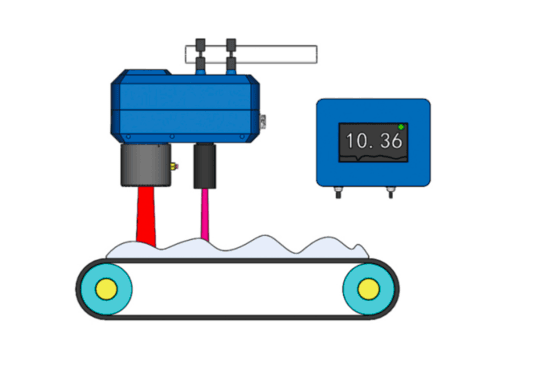
Start with the control decision, then choose the sensing location. For exposed, relatively even layers of wood fiber on a conveyor, a non-contact online NIR moisture analyzer can provide rapid trend data without contacting the material. Position it after drying or conditioning and before the blender when the goal is to stabilize furnish entering resin application.
If the question is moisture through a deeper, denser bed rather than at the exposed surface, assess a microwave moisture measurement system instead. It is designed for a through-belt or chute installation and can be a better fit where bed depth varies or bulk moisture is the control variable. The measurement method should follow material presentation; no single instrument setup is appropriate for every wood-fiber line.
Where to install the sensor
- After fiber drying or conditioning: use the signal to identify feed and dryer changes before they reach resin blending.
- Before the blender: relate moisture trend to resin-addition strategy and furnish flow, while retaining the plant's established formulation limits.
- After blending or mat formation: use a second, application-reviewed point when the process needs confirmation of the material presented to the press.
- At finished-board conditioning: use quality trending and moisture-release checks; this point is not a replacement for control upstream of the press.
The wood fiber and board materials application page summarizes common conveyor and conditioned-fiber installation points. A site survey should verify belt coverage, stand-off distance, vibration, dust accumulation, material depth, and access for cleaning before any final placement is approved.
Calibration and commissioning: make the online value useful
Build the calibration against representative samples taken from the same material stream and analyzed with the plant's approved reference method. Include the normal operating range as well as expected species, particle-size, resin, and temperature changes. Keep time-stamped samples so the laboratory result is paired with the correct online reading rather than with a later material batch.
During commissioning, define the required response time and averaging window, then compare trend direction before closing a control loop. Check for signal shifts caused by belt exposure, layer thickness, dust on an optical window, or changes in the material background. Use routine reference checks to verify model health; recalibrate when the furnish or process formulation changes materially.
Quality and energy benefits to evaluate
The practical benefit is earlier visibility, not a claim that moisture measurement alone fixes board quality. When a reliable online signal is connected to a disciplined operating response, a plant can investigate dryer drift sooner, avoid operating with an unnecessarily conservative drying margin, and make sampling more targeted. This supports steadier furnish preparation and gives the press team better context when density, bonding, thickness, or surface defects begin to move.
For an application review, document the wood species mix, moisture range, conveyor geometry, material depth, dryer location, and the decision the signal must support. That information is more valuable than selecting a sensor solely from a nominal accuracy figure.
Sources
- USDA Forest Products Laboratory, Wood Handbook: Moisture Relations and Physical Properties of Wood, Chapter 4. Definitions, hygroscopic behavior, and green-wood moisture context.
- USDA Forest Products Laboratory, Wood-Based Composites and Panel Products, Chapter 10. Conventional particleboard mat and post-press moisture ranges.
- USDA Forest Service, Dynamic Control of Moisture During Hot Pressing of Wood Composites. Pressing, vapor release, and manufacturing context.